A domain name is your unique address on the internet. When you register a domain name, you claim a piece of the internet over which you have full control.
You can use a domain name for a website and as the basis for professional email addresses.

A domain name is your unique address on the internet. When you register a domain name, you claim a piece of the internet over which you have full control.
You can use a domain name for a website and as the basis for professional email addresses.

The internet is a vast network of computers that communicate with each other. For this purpose, each computer has its own unique address: an IP address.
An IP address is a numeric address consisting of 4 groups of numbers between 0 and 255. Because the number of unique IP addresses in this form (IPv4) is running out, a new version was developed. This is called IPv6 and consists of 8 groups.
IP addresses are hard to remember. That’s why domain names are used. They mask the complexity of an IP address and are used to refer to the IP address of, for example, a website or mail server.
A domain name is made up of different parts, each separated by a dot.
At the end is the domain name extension – also called the 'top-level domain' or 'TLD.' There are now more than 1,200 unique domain name extensions. While most extensions can be used for various purposes, they often indicate specific uses. For example, .com suggests commercial use, while .org is for non-profit organizations. Each country also has its own domain name extension.
The part before the extension is called the 'second-level domain,' and you can choose it yourself. For instance, you can register your own name or that of your business. However, this part is subject to some technical limitations.
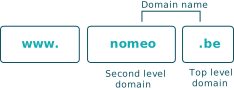
A web address usually starts with 'www.', but it is not part of a domain name. Your website is typically also accessible without typing www. before the domain name.
Based on a domain name, you can create additional addresses yourself for a specific application, e-shop, or customer portal. This is called a subdomain and always comes before the domain name.